






































































































































































Rucking for Beginners: A Safe 4-Week Plan, Gear, and Tips
Author: RVLNSV PRASAD
Updated On: October 2026
About Us
Author Bio
Editorial Policy
Contact Us
Introduction
Rucking for beginners is a practical way to make ordinary walking more challenging by carrying a backpack with a small amount of weight. You can start outdoors, on a walking track, or on a flat route near your home. You do not need a gym membership or expensive equipment to try it.
The important part is knowing how to start. Adding weight changes the demands placed on your muscles, joints, feet, and back. A backpack that feels manageable for five minutes may become uncomfortable after half an hour, particularly if the load shifts or the straps press against your shoulders.
That is why your first goal should not be to carry the heaviest backpack possible. It should be to complete a comfortable walk with good control, then gradually increase the challenge as your body adapts.
Research on walking with a backpack shows that carrying additional weight increases the energy required for movement. A laboratory study published in the Journal of Experimental Biology found that the metabolic cost of walking increased approximately in proportion to the carried load under its tested conditions. However, that research does not establish an exact calorie-burning figure for every person or recreational rucking session. You can read the peer-reviewed study on the mechanics and energy cost of load carriage.
This guide explains how to choose your equipment, select a sensible starting load, follow a four-week beginner rucking plan, and recognize when to increase the challenge or take a recovery day.
Quick Answer: How Should Beginners Start Rucking?
Start with a comfortable walk using an empty or lightly loaded backpack. Choose a flat, familiar route and walk for around 10–15 minutes if that duration feels manageable. If you already walk regularly, you may tolerate a little longer, but there is no need to rush.
Before adding more weight, check that the backpack sits comfortably, the contents do not move around, and you can walk without leaning forward excessively or changing your normal stride.
Cleveland Clinic recommends easing into rucking, beginning with a light load and increasing only one training variable at a time. Its beginner rucking guide also discusses backpack selection, load placement, and the risk of progressing too quickly.
A simple starting sequence is:
- Walk without additional weight to establish a comfortable duration.
- Add a small, secure load only if the unloaded walk feels manageable.
- Repeat a similar walk before increasing the duration or load.
- Monitor foot comfort, shoulder pressure, breathing, and recovery.
- Progress gradually rather than increasing weight, speed, and distance together.
Key Takeaways
- Rucking means walking while carrying a load, usually in a backpack.
- Beginners can start with an empty backpack before adding weight.
- There is no single starting load or percentage that is appropriate for everyone.
- A stable backpack, secure contents, comfortable shoes, and a suitable route matter.
- Increase only one major training variable at a time.
- Rucking can increase exercise intensity, but it does not guarantee a particular amount of fat loss or muscle growth.
- People with relevant health conditions, balance problems, or existing back, neck, foot, or joint pain may need professional advice before starting.
- Rucking should complement a balanced fitness routine rather than replace all other exercise.
What Is Rucking?
Rucking is walking while carrying a weighted backpack or rucksack. The term is associated with military training, where people carry equipment over set distances, but recreational rucking can be much simpler.
For fitness, the challenge comes from combining walking with an external load. Your legs move your body and the additional weight, while your trunk and upper body help manage the backpack.
Three variables shape the difficulty of a rucking session:
- Load: The total weight you carry.
- Duration and distance: How long or far you walk.
- Terrain and pace: Whether you walk on flat ground, hills, uneven paths, or at a faster speed.
These variables interact. A short walk with a heavier load may be more demanding than a longer walk with a light pack, but the exact effect depends on your fitness, walking speed, route, and how the backpack fits.
The research review on load carriage describes how factors such as carried mass, walking speed, terrain, and load placement influence the physiological cost of carrying a pack.
What Are the Benefits of Rucking?
Rucking combines the familiar movement of walking with additional resistance. It may be useful for people who enjoy outdoor exercise and want a way to make their walks more demanding.
However, evidence for general walking benefits is stronger than evidence for every specific claim about recreational rucking. It is important to distinguish what load-carriage studies demonstrate from what still needs more direct research.
1. It can increase exercise intensity.
Carrying extra weight requires additional work from your body. Research on loaded walking shows that energy expenditure generally increases as the carried load increases under controlled conditions.
A study published in the Journal of Experimental Biology measured walking with backpack loads and found that metabolic energy expenditure rose with added mass. The amount of extra energy required in everyday rucking will vary with the load, pace, terrain, and individual. Read the full study here.
This makes rucking one possible way to increase the challenge of a walking routine, but a heavier pack is not automatically better.
2. It can support cardiovascular fitness.
Walking is an accessible form of aerobic activity. Adding weight can increase the physical demands of the walk, although the intensity will depend on the person and the conditions.
The CDC’s adult physical activity guidelines recommend regular aerobic activity alongside muscle-strengthening exercise. Rucking may contribute to your overall activity, but it should be adjusted so that the added load does not compromise your ability to walk comfortably.
3. It challenges muscles involved in walking.
Your legs and trunk help you move and stabilize your body while carrying a backpack. The additional load changes the work required from the lower limbs and other structures involved in walking.
This does not mean that rucking replaces resistance training. If your main goal is to build substantial muscle strength or size, a structured strength-training program may still be necessary.
4. It can make walking more engaging.
Some people find a goal-oriented walk more enjoyable than simply counting steps. You might plan a short route, explore a park, or walk with a friend.
Outdoor activity may also help you establish a routine that fits your preferences. Enjoyment and consistency matter because a sustainable activity is easier to maintain than one that feels like a chore.
5. It offers a flexible alternative to gym-based exercise.
You can start with a suitable backpack and a safe route. Specialized equipment may improve comfort, but it is not essential for every beginner.
Rucking is not automatically superior to ordinary walking, running, cycling, or strength training. The best activity is one that matches your goals, abilities, and circumstances.
Rucking Versus Ordinary Walking
| Feature | Ordinary walking | Rucking |
|---|---|---|
| Additional load | None beyond normal clothing and carried items | A backpack or rucksack adds weight. |
| Exercise intensity | Depends on pace, incline, and duration | Also depends on the carried load. |
| Equipment | Comfortable footwear is usually enough. | Requires a secure, comfortable pack and stable load |
| Physical demands | Primarily walking-related | Walking demands plus load carriage |
| Beginner adjustment | Change pace or duration | Adjust load, duration, pace, and terrain. |
| Main safety consideration | Route, footwear, and walking tolerance | All walking considerations plus pack fit and load management |
Rucking may increase the effort required for walking, but the amount varies. There is no reliable universal percentage by which every rucking session burns more calories than an ordinary walk.
Essential Gear for Rucking Beginners
You do not need to buy a specialized rucksack immediately. Start with equipment that fits securely and allows you to walk comfortably.
1. Choose a stable backpack.
Look for a backpack with sturdy stitching, comfortable shoulder straps, and a secure closure. A chest strap or waist belt can help reduce bouncing when the pack is designed to use one.
The load should remain stable as you walk. A backpack that swings from side to side or presses a hard object into your back can make the session uncomfortable.
Cleveland Clinic explains the differences between ordinary backpacks and rucking packs in its guide to choosing rucking equipment.
2. Pack the weight securely.
Household items such as books or sealed water bottles can be used when they fit safely inside the backpack. Weigh them rather than estimating their mass by appearance.
Place the load close to your back and prevent it from shifting. Soft material can fill gaps around the load, but do not use loose objects that may move during the walk.
Avoid carrying sharp, fragile, or poorly secured objects. If the pack feels lopsided, bounces, or causes localized pressure, adjust it before continuing.
3. Select comfortable shoes.
Choose shoes that fit well and are suitable for the surface you plan to walk on. You may be comfortable in walking shoes or running shoes on flat paths, while rough trails may require footwear with better traction and support.
There is no single shoe type that works for everyone. The priority is comfort, a secure fit, and adequate grip for your route.
4. Wear breathable clothing.
Clothing should allow comfortable movement and suit the weather. On warm days, avoid overdressing, and consider sun protection when walking outdoors.
Carry water when needed for the duration, weather, and conditions of your walk. A hydration plan becomes especially important during longer sessions or hot weather.
How Much Weight Should Beginners Carry?
There is no universally safe starting percentage for every beginner. Body weight alone does not determine how well you tolerate a backpack load. Your walking experience, strength, balance, route, and health all matter.
For some people, the best first session uses an empty backpack. Others who already walk regularly may tolerate a very light load. Cleveland Clinic’s rucking guidance recommends starting lightly and building gradually rather than immediately carrying a heavy pack.
Use the following decision guide instead of treating a percentage as a rule.
| Your current situation | Practical starting point |
|---|---|
| You rarely walk for exercise. | Begin with ordinary walking and establish a comfortable duration. |
| You can walk comfortably but have never carried a load. | Try a short walk with an empty backpack. |
| You tolerate the empty backpack well. | Consider a very light, securely packed load. |
| You already walk regularly. | Add only a modest load and keep the first session shorter than your usual walk if necessary. |
| You experience pain, instability, or unusual fatigue. | Stop and reassess; seek professional advice when appropriate. |
Do not increase the load just because a particular percentage is recommended in an online article. Your own comfort and ability to maintain a natural walking pattern are more useful guides.
A Four-Week Rucking Plan for Beginners
This plan is a conservative example, not a validated clinical protocol. Adjust the schedule to your current walking capacity, and repeat a week if you need more time to adapt.
The first goal is to build a routine. You do not need to increase weight every week.
| Week | Sessions | Duration | Load and focus |
|---|---|---|---|
| 1 | 2 sessions | 10–15 minutes, if comfortable | Walk unloaded or with an empty backpack; practice fit and posture. |
| 2 | 2 sessions | 15–20 minutes | If week 1 felt comfortable, try a very light load; otherwise, repeat week 1. |
| 3 | 2 sessions | 15–25 minutes | Keep the load unchanged and extend the walk only if recovery is good. |
| 4 | 2 sessions | 20–30 minutes | Maintain the same load or increase one variable slightly if the previous sessions felt easy. |
These durations are starting examples, not targets you must achieve. If you are new to physical activity, shorter sessions may be more appropriate. If you already walk regularly, you may begin at a different level.
How to use the plan
Before each walk: Check your backpack, straps, footwear, route, and weather. Begin at a comfortable pace.
During the walk: Notice whether you can maintain your usual stride and keep the load stable. You should not have to lean forward excessively to compensate for the backpack.
After the walk: Record how long you walked, the load you carried, and how you felt. Note any unusual soreness or discomfort that affects daily activities.
Before progressing, make sure the previous sessions were manageable and that you have recovered. If not, repeat the same week or reduce the workload.
The One-Variable Progression Rule
One of the most useful habits for beginners is to change only one major training variable at a time.
You can adjust:
- Duration: Walk for a little longer while keeping the same load.
- Load: Add a small amount of weight while keeping the route and duration unchanged.
- Terrain: Introduce gentle inclines after you tolerate flat routes.
- Frequency: Add a session only when the existing schedule is manageable.
For example, if you comfortably complete two 15-minute walks with a light backpack, you might extend one walk slightly while keeping the load unchanged. If that proves difficult, return to the previous duration.
Cleveland Clinic’s beginner recommendations also advise gradual progression and caution against increasing multiple components simultaneously. See its rucking safety and progression advice.
There is no requirement to increase your load every week. Staying at the same level can be a sensible choice when you are adapting, recovering from a busy week, or managing a demanding route.
Proper Rucking Technique: A Practical Checklist
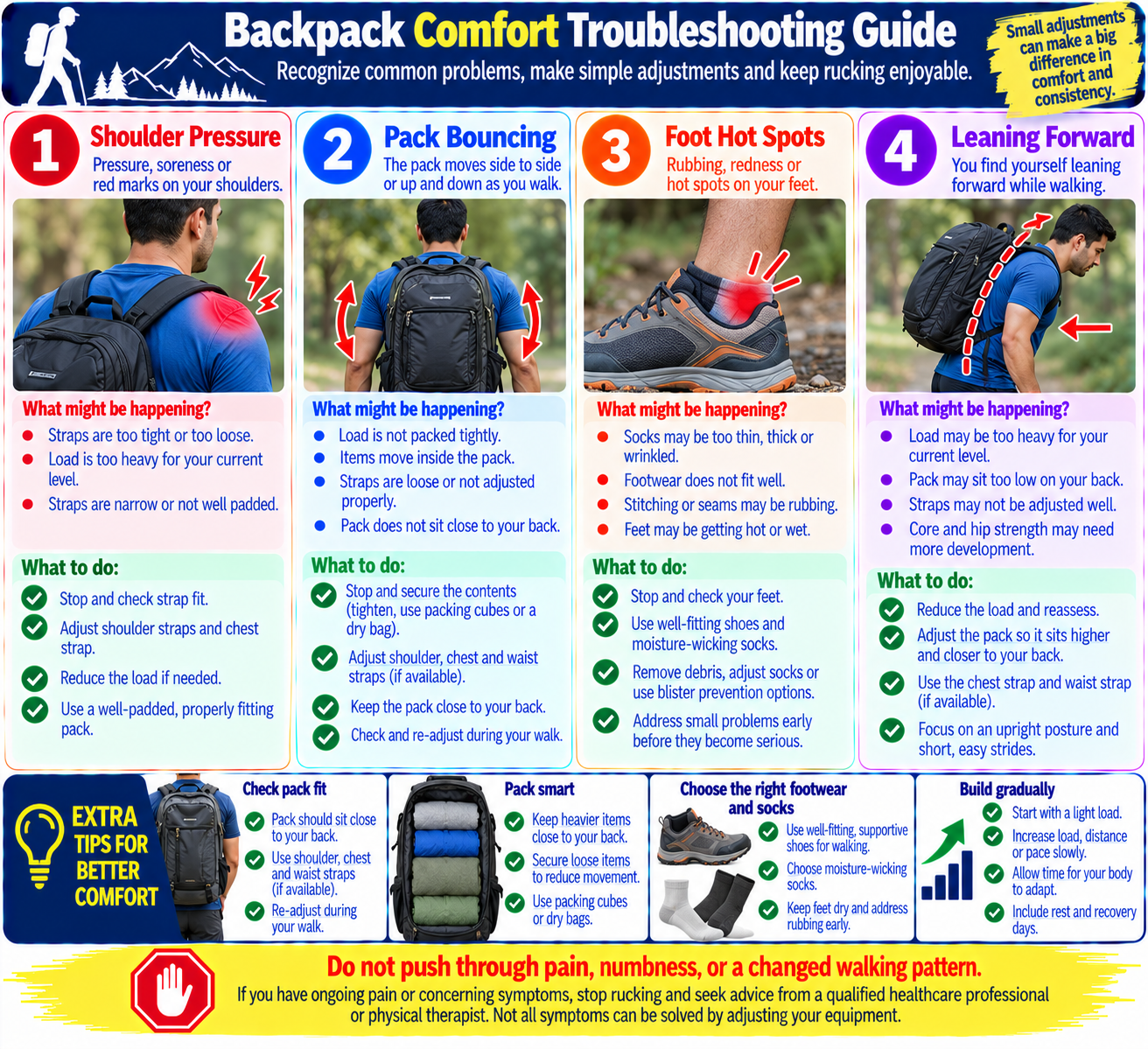
Good technique begins with a comfortable backpack and a load you can manage. You do not need to force an exaggerated military posture or hold your shoulders rigidly.
Before you start
- Check that the pack is secure and does not bounce.
- Make sure the contents cannot shift or press uncomfortably against your back.
- Confirm that your footwear is comfortable and appropriate for the route.
- Start with a short, easy warm-up walk.
While walking
- Look ahead naturally rather than staring at the ground for long periods.
- Keep your torso comfortably upright.
- Allow your arms to swing naturally when possible.
- Take a stride that feels controlled rather than deliberately lengthening it.
- Reduce your pace if you struggle to maintain your normal walking pattern.
When walking uphill or downhill
Uphill walking can increase the effort required, while downhill walking may place different demands on the legs. Avoid introducing steep hills at the same time that you increase your load.
Choose a manageable route first. Add more demanding terrain only after you can comfortably complete your current walks.
A Simple Rucking Readiness Check
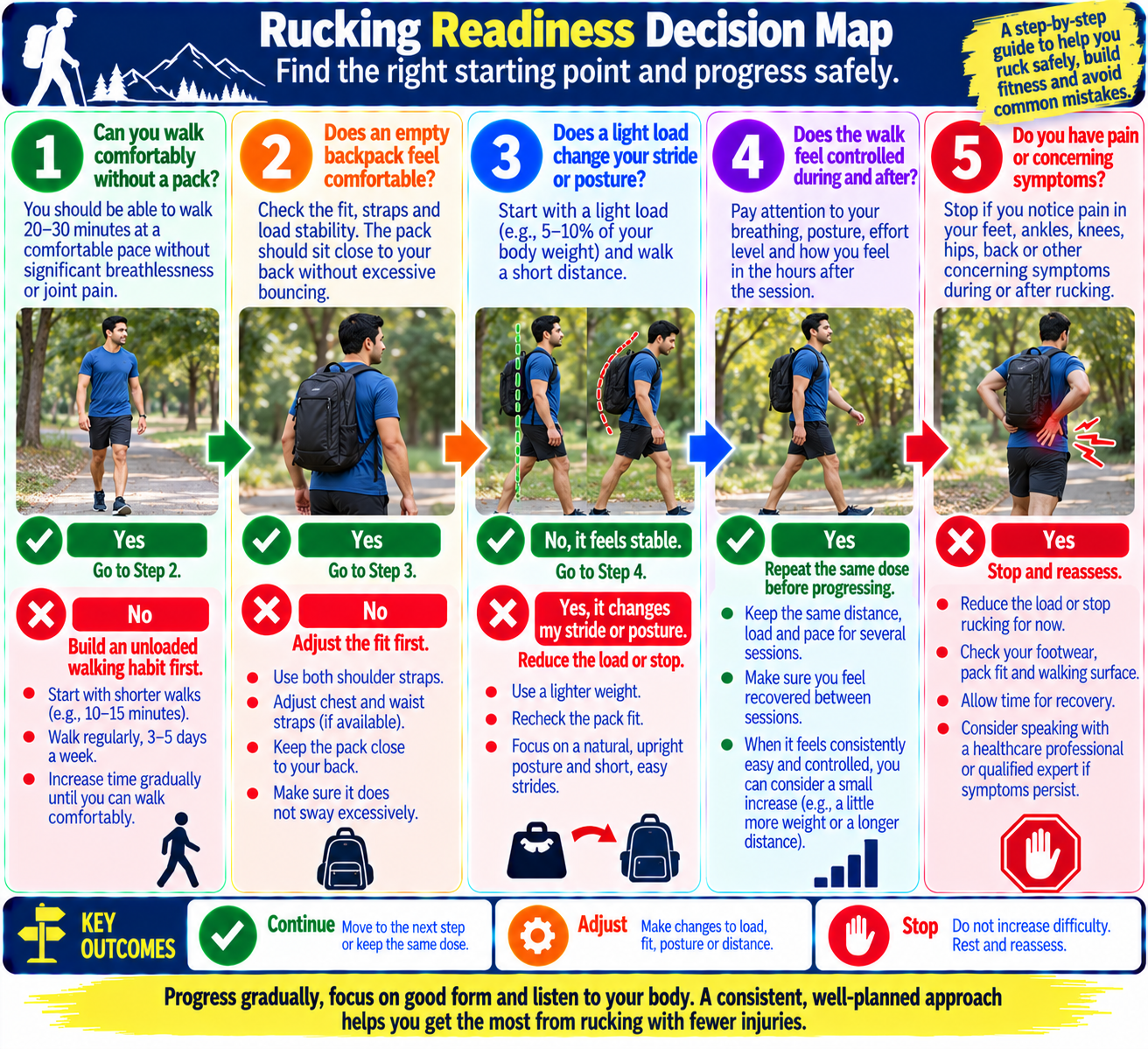
Before adding more weight, ask yourself five questions:
- Can I complete my current walk without needing to change my normal stride?
- Does the backpack stay stable without pressing painfully against my shoulders or back?
- Can I maintain a comfortable posture without excessive leaning?
- Have I recovered from my previous session?
- Can I complete the walk without unusual symptoms?
If the answer to any question is no, do not increase the load. You may need to reduce the weight, shorten the session, change the route, or return to unloaded walking.
This is a practical self-check, not a medical test or a guarantee that an activity is safe for everyone.
Common Rucking Mistakes to Avoid
1. Starting with too much weight
A heavy backpack may seem like a shortcut to better results, but it increases the demands of walking before you have established your tolerance.
Start with no load or a very light load, and build only when your current sessions feel manageable.
2. Increasing distance and weight together
A longer route combined with a heavier backpack creates a larger increase in total workload. If the session becomes too demanding, you will not know which change caused the problem.
Keep most variables stable when testing a progression.
3. Using an unstable backpack
A shifting load can create uncomfortable pressure and alter the way you walk. Secure the contents before leaving home, and stop to adjust the pack if it begins bouncing or moving around.
4. Treating discomfort as proof of progress
Rucking should feel like exercise, but pain is not a requirement for improvement. Persistent pain, altered walking mechanics, numbness, or unusual symptoms are reasons to stop and reassess rather than push through.
5. Rucking every day without recovery
Some people can tolerate frequent light walks, but carrying a load adds demands that may require more recovery. Beginners should not assume that daily weighted walking is necessary.
Start with a manageable frequency and adjust according to your response.
6. Assuming rucking replaces strength training
Rucking can challenge the legs and trunk, but it does not train every muscle group through the same range of motion as a structured strength routine.
The CDC’s adult activity recommendations include both aerobic activity and muscle-strengthening activity. Consider including appropriate strength exercises alongside walking.
What Does the Research Say About Calories and Weight Loss?
Rucking can increase the energy cost of walking because your body must move an additional load. However, the extra energy used varies with the weight carried, walking speed, terrain, duration, and individual characteristics.
A study measuring backpack load carriage found that energy expenditure rose as load increased under controlled conditions. The findings support the general principle that heavier loads require more work, but they do not establish a universal calorie-burn multiplier for recreational rucking. Read the peer-reviewed load-carriage research.
Weight loss is a separate question. It depends on overall energy balance, dietary intake, activity across the day, sleep, and other factors. Rucking may contribute to an active lifestyle, but it cannot guarantee fat loss.
Avoid claims such as “rucking burns exactly 40% more calories” unless the comparison is supported by an appropriate study that specifies the load, pace, duration, and participants. Even then, the result should not be presented as universal.
A more practical approach is to track your walking consistency, duration, comfort, and recovery rather than relying on calorie estimates from a wearable device.
Rucking and Mental Well-Being
Walking can provide a break from sitting and create an opportunity to spend time outdoors. Some people also enjoy the sense of purpose that comes from following a route or completing a planned session.
You might choose a quiet park, walk with a friend, or use the session as time away from screens. These are practical ways to make exercise more enjoyable, although individual experiences vary.
Do not assume that rucking treats a mental health condition or that a weighted walk is better for mental well-being than ordinary walking. If your goal is to improve your mood, choose a comfortable activity you can maintain and seek professional support when needed.
Who Should Be Careful With Rucking?
Adding weight is not appropriate for everyone. People with existing back or neck pain, significant joint problems, balance difficulties, or injuries affecting walking may need individualized advice before trying it.
Harvard Health’s discussion of weighted walking warns that additional load can strain muscles and joints and advises people with certain conditions to be cautious. Read its guidance on the benefits and risks of weighted walking.
Talk to an appropriate healthcare professional before starting if you have a condition that may affect your ability to carry a load safely or if you are unsure whether rucking suits your circumstances.
Stop your session if you develop chest pain, faintness, unusual shortness of breath, or other concerning symptoms, and seek appropriate medical attention. Do not continue simply to finish the planned distance.
How to Track Your Rucking Progress
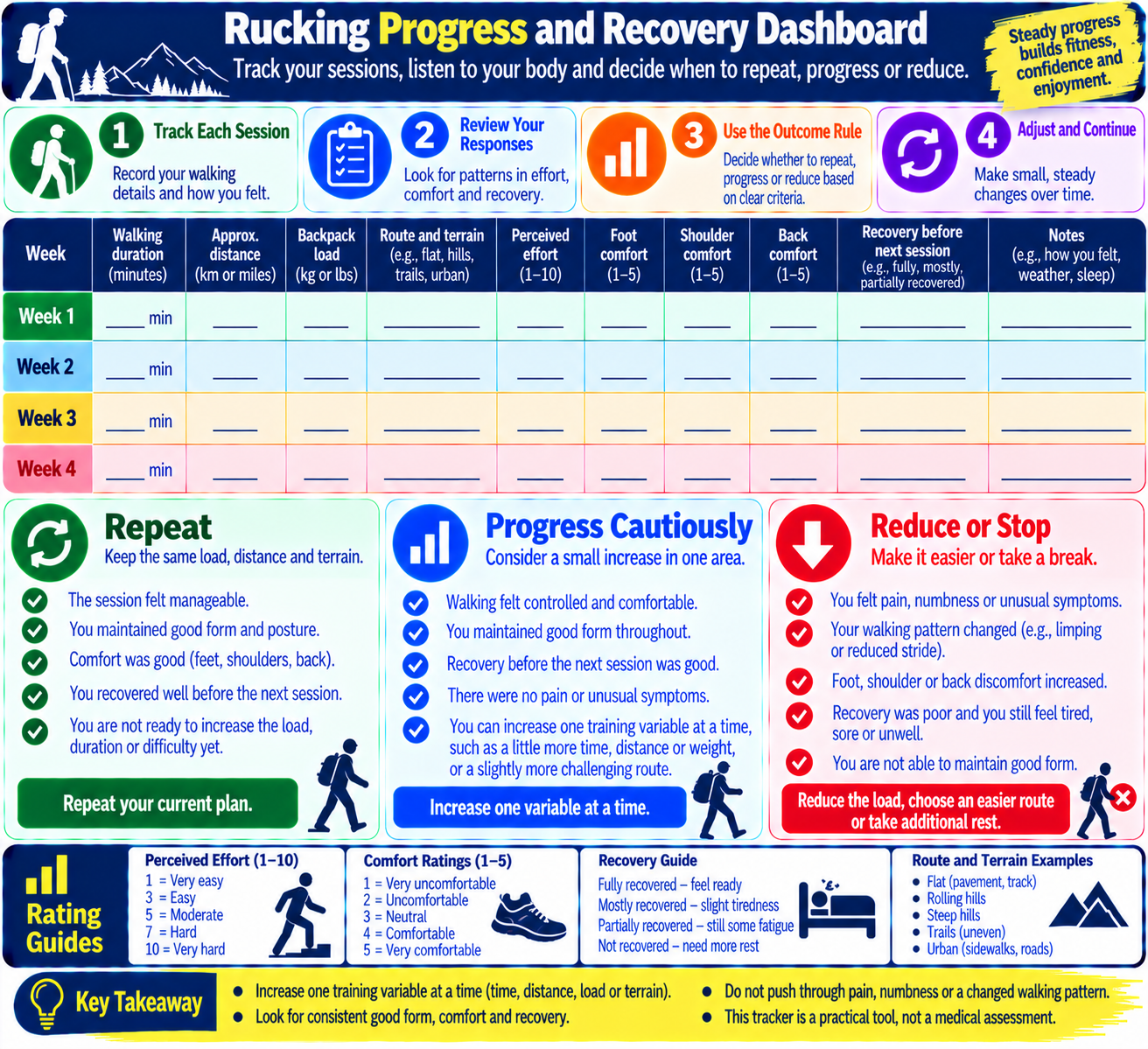
You do not need expensive technology to measure improvement. A notebook or simple phone note can help you recognize patterns and avoid increasing the workload too quickly.
Record these five details after each session:
| What to record | Why it helps |
|---|---|
| Duration | Shows whether you are gradually tolerating longer walks |
| Approximate distance | Helps you compare similar routes |
| Backpack load | Makes progression measurable |
| Comfort and perceived effort | Helps you identify sessions that were too demanding |
| Recovery before the next walk | Helps guide whether to repeat or adjust the workload |
For example, you might find that a 15-minute walk with a very light load feels manageable, while a longer walk causes shoulder discomfort. That information is more useful than increasing the weight simply because the calendar says it is time to progress.
The aim is not to improve every measurement every week. It is to develop a routine that fits your current ability and remains sustainable.
Frequently Asked Questions
1. Is rucking good for beginners?
It can be a useful activity for beginners who can walk comfortably and introduce the load gradually. People who are new to exercise can start with ordinary walking and an empty backpack before considering additional weight.
2. How much weight should I use for rucking?
There is no universal starting weight. Your walking experience, health, balance, and ability to manage the backpack matter more than a single percentage of body weight. Start unloaded or very lightly loaded, and increase only if your current walks feel comfortable.
3. How long should a beginner ruck?
A short 10–15-minute session can be a reasonable starting example for someone who tolerates that duration. Shorten it if necessary, and build gradually rather than aiming for a particular distance immediately.
4. Can I go rucking every day?
You may be able to walk regularly, but daily weighted sessions are not necessary. Start with a manageable schedule, allow recovery, and adjust based on how you feel after each walk.
5. Does rucking burn more calories than walking?
Carrying a load generally increases the energy required for walking under comparable conditions. The difference varies with load, pace, terrain, duration, and individual characteristics, so there is no single calorie-burn percentage that applies to everyone.
6. Do I need a special rucking backpack?
Not necessarily. A sturdy backpack that fits comfortably and holds the load securely may be sufficient for short beginner sessions. A purpose-built rucksack can offer features that improve load stability and comfort.
7. Is rucking better than running?
Neither is automatically better for everyone. Rucking and running place different demands on the body. The right option depends on your goals, fitness, health, preferences, and ability to recover.
8. Can rucking help me lose weight?
It may contribute to your overall physical activity and energy expenditure. Weight loss, however, depends on your broader eating and activity habits, and rucking alone does not guarantee a particular result.
9. Should I use hills during my first rucking sessions?
Flat, familiar routes are generally easier to manage when you are learning how a backpack feels. Introduce hills gradually after you can complete your current sessions comfortably.
10. What should I do if my back or shoulders hurt?
Stop and remove the load. Check whether the backpack fit or load placement contributed to the discomfort, but do not assume that adjusting the straps will solve every problem. If pain persists, returns, or is significant, seek appropriate medical advice before resuming.
Conclusion
Rucking for beginners can be a practical way to make walking more challenging without joining a gym or buying specialized equipment. A comfortable backpack, a safe route, and a gradual approach are enough to get started.
Begin with an unloaded or lightly loaded walk, and focus on maintaining a natural stride and comfortable posture. Increase only one major variable at a time, whether that means walking a little longer, adding a small amount of weight, or trying a slightly more demanding route.
Keep your expectations realistic. Rucking can increase the physical demands of walking, but it does not guarantee a particular amount of calorie burn, weight loss, or muscle growth. Your results will depend on consistency, recovery, overall activity, and individual circumstances.
The best starting point is the one you can manage comfortably today. Build from there, keep track of how you respond, and allow your progress to guide your next step.
Author Note
Author: RVLNSV PRASAD
This article provides general, evidence-informed guidance for people interested in beginning recreational rucking. It distinguishes research on load carriage from claims about guaranteed weight loss, calorie expenditure, or strength gains.
Add personal experiences or client stories only when they are genuine and accurately described. If you have personally tried rucking, you may include specific observations about backpack fit, route selection, or how you adjusted the workload, provided they reflect your actual experience.
Medical Disclaimer
This article is for general educational purposes and is not a substitute for individualized medical advice, diagnosis, or treatment. Rucking may not be suitable for everyone, especially people with certain musculoskeletal conditions, balance problems, or health concerns that affect exercise. Consult an appropriate healthcare professional if you are unsure whether carrying a load while walking is suitable for you. Seek prompt medical attention for concerning symptoms such as chest pain, faintness, or unusual shortness of breath.
Fitness Disclaimer
The four-week schedule and suggested durations are examples, not a personalized training prescription or a guarantee of safety. Adjust the plan to your current ability, choose stable equipment, and stop if pain or unusual symptoms occur. Do not increase weight, distance, speed, and terrain difficulty simultaneously.
Evidence and Further Reading
- Cleveland Clinic — What Is Rucking? — Practical advice on equipment, starting loads, technique, progression, and potential benefits.
- Harvard Health Publishing — What Are the Benefits of Walking With a Weighted Vest? — Discusses possible benefits and risks of weighted walking. A weighted vest is not identical to a backpack, so not every finding transfers directly to rucking.
- Journal of Experimental Biology — Mechanics and Energetics of Load Carriage During Human Walking — Research on the mechanical work and energy cost associated with carrying backpack loads.
- PubMed—Load Carriage Using Packs: A Review of Physiological, Biomechanical, and Medical Aspects—Reviews factors influencing load carriage, including mass, speed, terrain, and load placement.
- CDC—Adult Physical Activity Guidelines—Official recommendations for aerobic activity and muscle-strengthening exercise.
- Harvard Health Publishing — Get More Out of Your Daily Walk — General walking guidance and information on adding resistance to walking.
Related Content
- Active Living
- 15 Pilates Exercises for Beginners: A Gentle Start to Core Strength and Flexibility
- HIIT Workouts for Beginners: How to Start and See Results Fast
- The 3 Best Beginners Weight Training Tips
- Healthy Eating Meal Plan for Wellness
- 4 Best Exercises for Health











[…] Rucking for Beginners: Gear, Tips, and Training Plans […]